

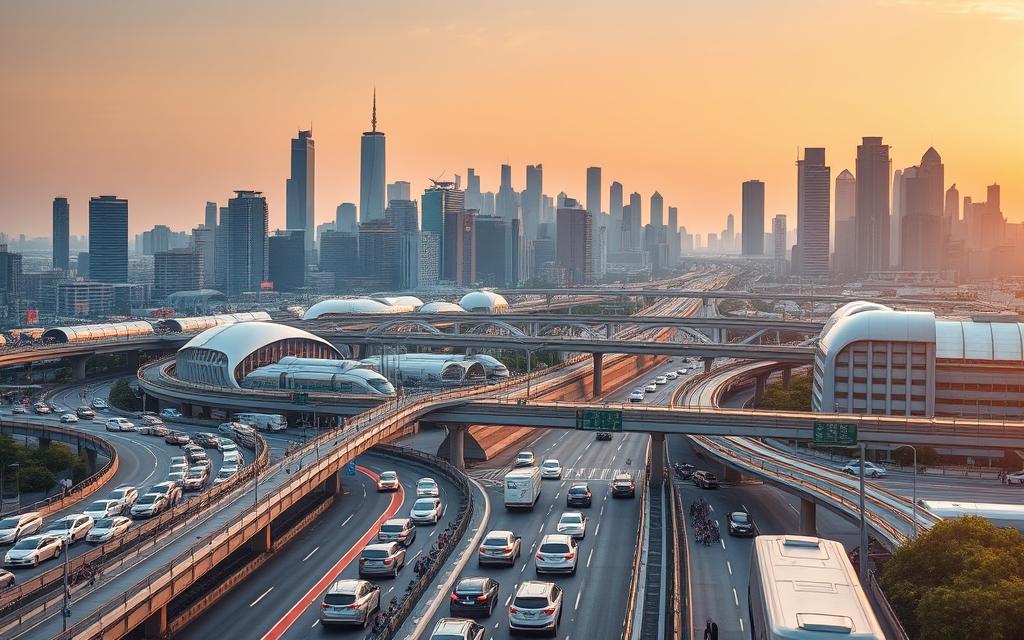
Digital innovations are changing our transport networks in amazing ways. Now, systems can stop accidents before they start, not just after.
Jonathan Wood’s research at Iowa State University shows this big change. His work proves that crash prevention and lane assist systems are better than old safety methods like rumble strips.
These new technologies are more than just extra features. They’re changing our roads in big ways. The use of transportation safety technology makes our networks smarter and more ready to respond.
This change brings big benefits: fewer accidents, less severe injuries, and lower costs. Our roads are getting safer, and we’re moving people and goods better than ever.
The Role of Technology in Modern Transportation Systems
Transport systems have changed a lot. They’ve moved from simple roads to complex digital networks. This change is a big step forward in solving mobility problems.
From Traditional to Tech-Driven Approaches
Old days, safety in transport was mainly about physical barriers. Things like rumble strips and guard rails were used. But they were not perfect and often couldn’t stop accidents.
Now, we use digital tech to make transport safer. Systems can now predict dangers and act fast. This new way is a big change in how we think about safety.
Core Technologies Shaping the Future
Many new techs are changing transport. Advanced Driver-Assistance Systems (ADAS) help drivers avoid accidents. They do things like stop the car automatically if needed.
Related Posts:
- Information Technology in the Hospitality Industry…
- How Technology Will Change Architecture in the…
- What Is Appropriate Technology Sustainable Solutions…

- How Technology Is Beneficial to Education Enhancing…

- What Is a Head of Technology Leadership in the Tech Industry

- The Benefits of Information Technology Efficiency…

Vehicle-to-Everything (V2X) communication lets cars talk to each other and the road. This V2X communication helps avoid crashes and makes traffic flow better.
The Internet of Things (IoT) links roads to digital systems. Smart sensors check the road and bridges. Artificial intelligence uses this info to plan maintenance and manage traffic.
| Traditional Approach | Tech-Driven Solution | Improvement Factor |
|---|---|---|
| Physical rumble strips | Lane departure warning systems | 67% reduction in lane drift incidents |
| Manual traffic policing | AI-powered traffic monitoring | 3x faster incident response |
| Reactive maintenance | Predictive infrastructure analytics | 40% cost reduction in repairs |
Studies show tech-based solutions are better for safety and efficiency. These systems make transport safer and smarter.
How Technology Has Improved Transportation Safety
Transportation safety has seen a big change thanks to new technology. These new systems protect everyone on the road and make driving safer.
Advanced Driver-Assistance Systems (ADAS)
Today’s cars have ADAS tech that stops accidents before they start. They use sensors and cameras to watch the road and help the driver.
Some key ADAS features are:
- Lane departure warnings that alert drivers when unintentionally drifting
- Automatic emergency braking that detects impending collisions
- Driver monitoring systems that detect fatigue or distraction
- Adaptive cruise control that maintains safe following distances
Real-World Applications: Tesla Autopilot and Mercedes-Benz Drive Pilot
Big car makers like Tesla and Mercedes-Benz have made their cars safer. Tesla’s Autopilot has features like lane keeping and cruise control. It uses cameras to understand the road.
Mercedes-Benz’s Drive Pilot is another big step forward. It lets cars drive on some motorways in Germany. It uses sensors to keep the car safe.
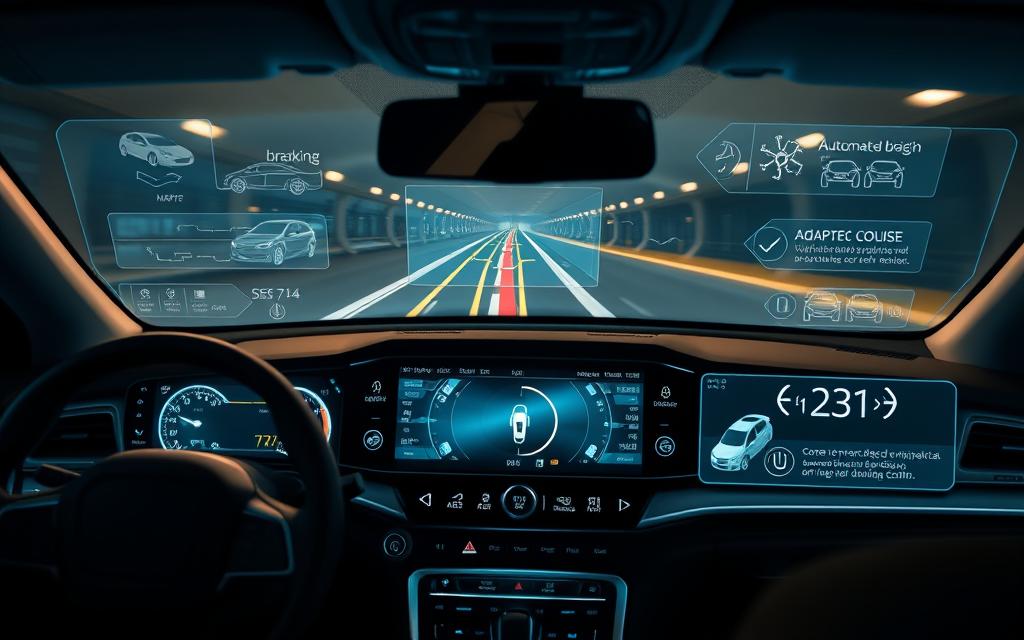
Studies show cars with ADAS have 27% fewer accidents. They are best at stopping rear-end crashes and cars leaving the road.
Vehicle-to-Everything (V2X) Communication
V2X tech lets cars talk to everything around them. This makes the road safer for everyone. Cars can share info with other cars, roads, and even people’s phones.
This tech uses special signals to send:
- Real-time hazard alerts from other connected vehicles
- Traffic signal status and timing information
- Road condition warnings from infrastructure sensors
- Pedestrian detection through smartphone connectivity
Deployment in Cities like London and Manchester
Big UK cities like London and Manchester are using V2X tech. London uses it at dangerous spots to warn drivers. It helps a lot with accidents involving people on foot or bike.
Manchester’s V2X works with its smart traffic management. It makes traffic signals change based on what cars say. This has cut down on accidents by 15%.
These systems are the future of road safety. Cars will work together to make roads safer. This tech will keep making driving safer for everyone.
Boosting Efficiency with Intelligent Transport Solutions
Technology brings big improvements in transport efficiency, not just safety. It uses smart systems to make operations better and use less resources. These changes help people and goods move more easily in cities and are kinder to the environment.
Smart Traffic Management and Adaptive Signals
Modern cities use AI and real-time data to change traffic flow. Smart traffic systems watch how vehicles move and adjust signals to match the traffic.
Adaptive signal control is a big step up from old traffic lights. It uses sensors and cameras to see how busy the roads are. Then, it changes signal times to cut down on traffic jams.
Studies show adaptive traffic systems can cut travel times by 10-25%. They also reduce fuel use and emissions by the same amount. These techs help make cities better places to live and work.
Case Study: Siemens Mobility in UK Smart Cities
Siemens Mobility has brought advanced adaptive signal tech to UK smart cities. Their systems use smart algorithms to adjust signal times every few seconds based on traffic.
In one UK city, Siemens’ tech cut journey times by 15% during busy hours. It also reduced stopped times by 22% and cut nitrogen oxide emissions by 12% by making traffic flow smoother.
These examples show how smart traffic management fits into bigger plans for city mobility. It works with public transport and cycling to make cities more efficient.
Electric and Hybrid Vehicle Technologies
Going electric is key to making transport more efficient. Electric cars use over 77% of electrical energy to move, compared to 12-30% for petrol cars.
Charging tech has improved a lot. Now, rapid chargers can add 100 miles of range in under 15 minutes. Smart charging systems charge cars when it’s cheapest or when there’s lots of green energy.
Electric cars can also help the grid. They can store energy and send it back to the grid when it’s needed most.
Innovations in Models like BMW i3 and Jaguar I-Pace
The BMW i3 shows how design and tech can make cars more efficient. Its light body and smart energy capture system help it go further.
The Jaguar I-Pace has a smart thermal system to keep the battery at the best temperature for efficiency. It also predicts how far you can go based on your route and traffic.
Both cars can warm up the cabin while charging, so it’s comfy when you start driving. This saves battery power for driving.
The table below shows how electric and hybrid cars are more efficient:
| Vehicle Model | Energy Consumption (kWh/100km) | Equivalent Petrol Efficiency (mpg) | Fast Charging Capability | Energy Recuperation Efficiency |
|---|---|---|---|---|
| BMW i3 | 13.6 | 130 | 80% in 40 minutes | Up to 75% |
| Jaguar I-Pace | 21.2 | 85 | 80% in 45 minutes | Up to 70% |
| Toyota Prius Hybrid | N/A (petrol-electric) | 65 | N/A | Up to 60% |
| Nissan Leaf | 17.0 | 105 | 80% in 40 minutes | Up to 70% |
These efficiency improvements are not just for cars. They help the whole transport system. Electric cars and smart charging make energy use better and help the grid.
Intelligent transport solutions bring big gains in efficiency. From smart traffic to electric cars, these techs make our cities better and greener.
Data Analytics for Operational Optimisation
Transport systems produce huge amounts of data daily. Smart analysis of this data opens up great chances for better operations. Data analytics is key in modern transport optimisation, changing how companies look after their assets and manage their fleets.
Predictive Maintenance in Rail and Aviation
Predictive maintenance is a game-changer for asset management. Instead of sticking to set schedules, companies use AI to check real-time sensor data. This lets them spot mechanical problems before they happen.
In aviation, Airbus and Boeing use advanced predictive systems. Their algorithms watch over thousands of flight details to spot issues early. This approach cuts down on unplanned maintenance and boosts aircraft availability.
Rail networks also gain from these technologies. Trains and tracks have sensors that send performance data non-stop. Advanced analytics can forecast when parts might fail, days or weeks ahead. This stops service breaks and makes travel safer.
Fleet Management Tools by Companies like Verizon Connect
Modern fleet management tools mix different technologies for better operations. Verizon Connect and others offer platforms that combine GPS, telematics, and data analytics. These tools give a clear view of how fleets are doing in real-time.
The systems look at many things to find ways to improve:
- Route efficiency and fuel use patterns
- Driver habits and safety signs
- Vehicle health checks and when maintenance is needed
- Delivery times and how happy customers are
Studies show big wins from using these tools. Companies see 15-20% less fuel costs and better delivery times. The data-driven way also makes customers happier with more reliable service.
These advanced tools lay the groundwork for new ideas. The data helps in making autonomous vehicles and better public transport integration. As analytics gets better, transport systems get smarter and more efficient.
Connected and Autonomous Vehicles: A New Era
The world of transport is changing in a big way. Connected and autonomous vehicles are not just small updates. They are changing how we think about moving around. These new technologies could make travel better and greener by using less energy and finding the best routes.
Levels of Automation and Current Capabilities
The Society of Automotive Engineers has six levels of car automation. Most cars today are at Level 2 or Level 3. They can steer and speed up but need a person to help.
These cars use advanced sensors and machine learning to drive. They are getting better at making decisions on the road. This is making driving safer and more comfortable.
Examples: Waymo One and General Motors Super Cruise
Waymo One is a robotaxi service in some areas. It’s a Level 4 system that uses many sensors. It’s safe but faces challenges in busy cities and bad weather.
General Motors Super Cruise lets you drive hands-free on highways. It uses GPS and checks if you’re paying attention. Both show how far we’ve come but also the challenges ahead.
| System | Automation Level | Operational Domain | Key Technologies |
|---|---|---|---|
| Waymo One | Level 4 | Urban environments | Lidar, camera arrays, machine learning |
| Super Cruise | Level 2 | Highways only | LiDAR map data, driver monitoring |
| Tesla Autopilot | Level 2 | Various road types | Computer vision, neural networks |
Integration with Public Transport Networks
Autonomous vehicles could make public transport better. They can help with getting to and from public transport. This makes travel easier and less reliant on cars.
Cities are testing self-driving shuttles to connect to public transport. These shuttles run on set routes and schedules. They make public transport more reliable and appealing.
Using autonomous vehicles with public transport helps the environment. It reduces the need for cars and saves energy. This smart way of moving around is the future of cities.
Sustainable Transport Technologies
The transport sector is at a turning point. It must balance environmental care with new tech. New transport solutions aim to cut carbon emissions while keeping travel efficient.

Renewable Energy in Transport: Solar and Hydrogen
Renewable energy is changing transport for the better. Solar cars are now a reality, used in public transport and big fleets. They use solar panels to capture energy.
Hydrogen fuel cells are another green option. They turn hydrogen into electricity, making cars zero-emission. Big car makers are investing in this tech for long trips.
These green transport options are a big win for the planet. They can cut greenhouse gas emissions by up to 90%. This makes them key in fighting climate change.
High-Speed and Hyperloop Developments
High-speed trains are leading the way in fast, green travel. They carry lots of people at over 250 km/h, using less energy than planes. Europe and Asia show how these networks can connect regions.
Hyperloop tech is the most exciting new idea. It uses tubes and magnets to move pods fast and cheaply. Companies are working on it, with test tracks showing it works.
Hyperloop systems could be super efficient. They could go up to 1,200 km/h, using less energy than trains or planes. This could change how we travel long distances.
Using data analytics transportation is key to making these green techs better. It helps adjust energy use and more for better efficiency.
| Technology | Maximum Speed | Energy Consumption | CO2 Reduction |
|---|---|---|---|
| Conventional High-Speed Rail | 320 km/h | 0.05 kWh/passenger-km | 75-85% |
| Solar-Powered Vehicles | Varies by type | 0.02 kWh/km (average) | 90-95% |
| Hydrogen Fuel Cell Vehicles | 180 km/h (commercial) | 0.8 kWh/km (equivalent) | 85-90% |
| Hyperloop Technology | 1,200 km/h (projected) | 0.03 kWh/passenger-km | 95-98% |
These green transport options are more than just good for the planet. They also meet our growing need for travel while being kind to the environment. As they grow, they’ll be key to making travel both fast and green.
Getting to green transport takes many tech paths. Each one helps reduce harm to the environment. For more on how tech is changing transport, check out these 8 ways technology transforms transportation logistics. They show more innovations that will shape our future travel.
Conclusion
Transportation has changed a lot thanks to new technology. Safety and efficiency have improved a lot in all ways of moving people and goods. New tech like advanced driver systems and smart traffic management are changing how we travel.
The use of IoT in logistics has changed how we see and manage supply chains. AI is making transportation smarter by predicting and making decisions on its own. These advances are making roads safer, routes better, and helping the environment.
New tech is on the horizon, promising even more changes. Connected cars, green energy, and hyperloops are coming. We’re moving towards cars that drive themselves and don’t pollute, thanks to constant innovation. This is all about making travel safer and more efficient for everyone.